
It’s 3 a.m.
The baby is crying. Your partner is feeding again, for what feels like the tenth time tonight.
And you’re standing in the doorway, wide awake, not sure what to do with your hands.
You want to help. You’d do anything to help. You just don’t know what helping looks like right now.
If that’s you, you’re not failing. Most new partners feel this at some point in the first two weeks. And there’s far more you can do than it seems from that doorway.
What actually helps in the first two weeks?
Small, practical things. Done without being asked.
Take everything that isn’t feeding. Diapers, burping, settling, baths, laundry, dishes. When baby isn’t feeding, many partners make the rest of that wake-up their job.
Look after the person doing the feeding. A full water bottle within reach. A snack. Phone charger. Pain relief on time, if needed.
Be the gatekeeper. Visitors, texts and well-meant advice all add up. You can be the one who replies, “We’re resting today, maybe next week.” It’s much easier for you to say than for her.
Protect her rest. After a feed, take the baby into another room or out for a walk. She’ll sleep more deeply when she isn’t listening for every sound.
Notice instead of asking. “What do you need?” is kind, but it hands her one more thing to work out. “I’m putting a wash on and making lunch, anything to add?” is easier to answer.
Get your own time with the baby. Skin-to-skin on your chest, a slow walk in the carrier, the bedtime diaper. This is how you two get to know each other.
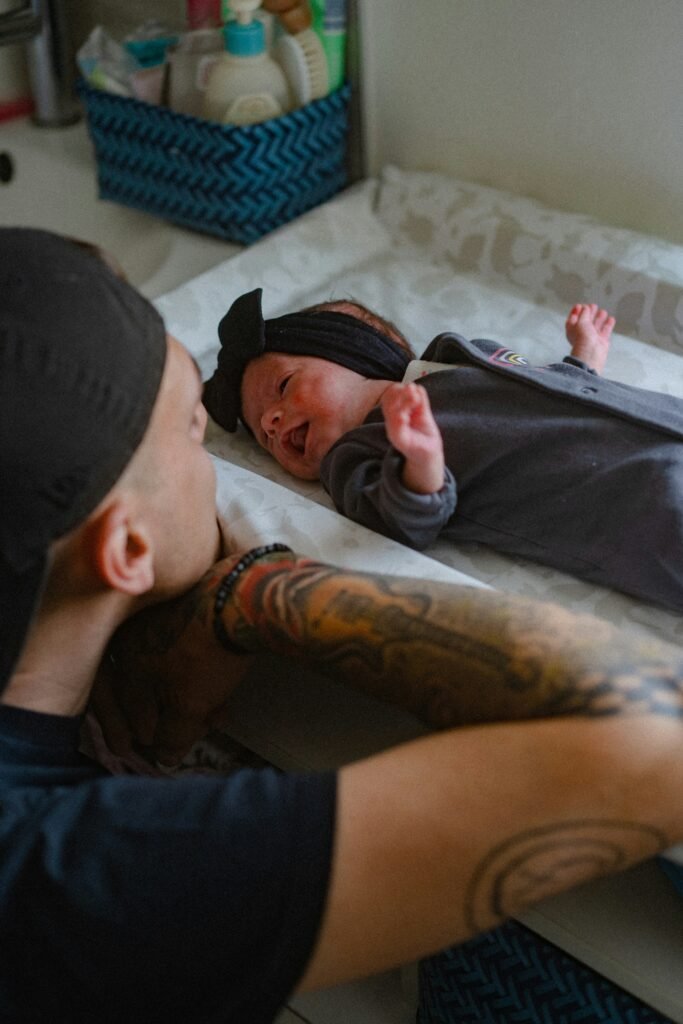
How can you share the nights?
There isn’t one right way. It depends on how your baby is fed, whether you’re back at work, and how each of you copes with broken sleep.
Here are three approaches families often use:
- Shifts. One of you is “on” for the first half of the night, the other for the second. This tends to suit families using bottles, whether that’s expressed milk or formula.
- Splitting each wake-up. She feeds. You do the diaper, the burping and the settling, so she’s back asleep sooner.
- The morning handover. You take the baby after the first early feed, and she gets one longer stretch of sleep.
If you’re holding the baby and feel yourself nodding off, lay them on their back in their own crib or bassinet. Being safe matters more than being heroic.
Neither of you will get enough sleep in these weeks. The aim isn’t to split it evenly to the minute. It’s that neither of you runs completely empty.
What’s worth keeping an eye on?
You see her more than anyone else right now. That makes you the person most likely to notice if something is off.
Tears, mood swings and feeling overwhelmed in the first days are very common. This is often called the baby blues. HealthLink BC notes they usually peak around day four and ease within two weeks.
You don’t have to fix it. Listening, food and sleep go a long way.
It may be worth a call to her doctor, midwife or public health nurse if:
- her low mood or anxiety lasts longer than two weeks, or keeps getting worse
- she’s finding it hard to look after herself or the baby
- she seems unlike herself in a way that worries you
Postpartum depression affects up to 15 in 100 women. It’s common, it’s treatable, and it’s nobody’s fault.
If she ever talks about harming herself or the baby, treat it as urgent. Call 9-1-1, or call or text 9-8-8 at any time.
For questions that aren’t urgent, you can call 8-1-1 in BC to speak with a HealthLink BC nurse. That includes her physical recovery, such as bleeding that’s getting heavier, a fever, or pain that’s getting worse rather than better.

Caption: You see her every day. That makes you well placed to notice when something has changed.
What about how you’re doing?
You’ve been through something big too.
You may have watched a birth that didn’t go to plan. You’re not sleeping. You might be back at work within days, quietly worrying about everyone at home.
Partners can struggle as well. Island Health reports that depression around the time of a birth affects roughly 10 to 12% of new fathers and non-birthing partners. The real figure is likely higher, because it’s so often put down to tiredness.
If you’ve felt flat, irritable or withdrawn for more than a couple of weeks, it’s worth talking to your own doctor. In BC, the Pacific Postpartum Support Society also offers support for partners.
Looking after yourself doesn’t take anything away from her. It’s part of how you keep showing up.
What if you both need more hands?
Sometimes two tired people aren’t enough. That isn’t a sign either of you is doing it wrong.
More hands can look like a lot of different things:
- a parent or sibling who drops off dinner twice a week
- a friend who holds the baby for an hour so you can both sleep
- a neighbour who walks the dog or does a grocery run
- professional support, such as a postpartum doula or overnight newborn care
Some families lean on one of these. Many use a mix. There’s no right answer, only what works in your home.
The bottom line
You don’t need to be an expert to be a good partner in these two weeks.
You can’t do the recovering for her, and you may not be able to do the feeding. But you can take the diapers, guard her sleep, keep her fed, hold the door against visitors and notice how she’s really doing.
That isn’t standing on the sidelines. That’s half the work.
So the next time you’re in that doorway at 3 a.m., you’ll know where to start: pick up the baby, pass her the water, and tell her you’ve got the next part.